
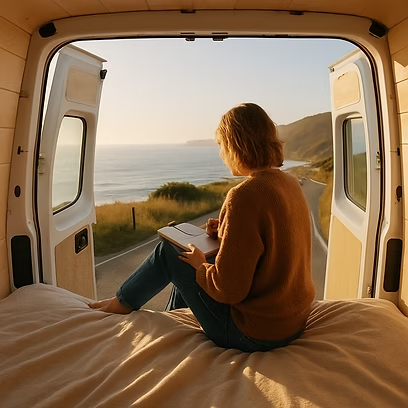
Designing a Later Life That Feels True to You
When most of us picture “retirement,” we imagine a familiar script: you work for decades, you stop around your mid-60s, and then you enter a long stretch of life that looks nothing like the years before it. That model has shaped expectations for generations, but it’s a model built for a world that simply doesn’t exist anymore.
Today, life is longer, more flexible, more connected, and far more personal than it was even 30 years ago. And that means the old idea of retirement -a single, fixed event- is becoming outdated.
At TFP, we’re seeing a quiet but powerful shift: people are beginning to design lives that don’t separate “work” and “retirement” so sharply, but instead weave together purpose, rest, flexibility, contribution, and wellbeing across every stage of life.
This is not about working forever.It’s about imagining your future with more creativity, and planning for it with more intention.
Later Life Isn’t Just Longer – It’s Different
For many of our clients, their 60s and 70s don’t feel like the “slowing down” era they once were. People are healthier for longer, more connected than ever, and increasingly unwilling to squeeze all their meaningful living into a single chapter at the end.
A few shifts we see every day:
1. People feel younger for longer
It’s common for people in their 70s to feel as energetic and capable as their parents did in their 50s. That changes not just how long retirement lasts, but what people want from it.
2. Work doesn’t look like it used to
Portfolio careers, consulting, self-employment, and remote working mean people have more freedom to shape their working life around their values, including in later years.
3. Technology makes flexibility normal
With a smartphone and a good Wi-Fi signal, people can work, volunteer, study, or stay connected from almost anywhere. Traditional constraints are falling away.
These aren’t fleeting trends… they’re reshaping expectations of later life entirely.
A New Possibility: Retirement as a Series of Choices, Not a Single Event
Rather than imagining retirement as a cliff edge, many people are beginning to see it as a spectrum. Not a full stop, but a collection of smaller transitions that unfold over time — each one adding richness, rest, discovery, or purpose.
Here are some real-life patterns we see emerging:
Mini-breaks that prevent burnout
Some clients choose to take career pauses every so often: a month to reset, a summer to reconnect with family, or a planned season of stepping back to breathe. These breaks keep energy levels high and work feeling meaningful.
Testing dreams before committing to them
Instead of waiting until 65 to spend a winter in a warm climate or try life by the sea, people are trialling those ideas earlier… long weekends, month-long stays, or remote working spells. It turns vague “one day” ideas into lived experience.
Blended working in later life
Many people find that stopping work completely doesn’t feel right, not financially, not emotionally, and not socially. Light consulting, mentoring, or part-time roles offer the best of both worlds: freedom and purpose.
A retirement that isn’t 30 years long
Rather than saving everything for a long and distant retirement, people are spreading meaningful experiences throughout their life, making later life feel less like a final chapter and more like the continuation of a story well lived.
This gentler, more flexible shape gives people the chance to live more now and later… without sacrificing wellbeing in either stage.
Why Experience Beats Guesswork
One of the most difficult things in long-term planning is predicting how your future self will actually feel. You might imagine loving long stretches of unstructured time — until you try it. Or you might believe you’d never want to work past 65, until you reach your 60s feeling energised and engaged.
This is where experimentation becomes powerful.
Trying things in small, low-risk ways gives you real data about what you enjoy, what restores you, and what type of balance feels sustainable.
Some clients dip their toes into:
- working from a different part of the country for a few weeks
- renting in a dream location before deciding to move
- volunteering in areas they’ve always been curious about
- taking a structured break between roles
- testing part-time work before making a full transition
These experiments often bring far more clarity than any amount of imagining. And financially, small trials can be surprisingly affordable, especially compared with the cost of building a retirement plan around assumptions that later prove untrue.
Financial Planning for a Flexible Future
If later life is becoming more versatile, then financial planning needs to be equally adaptable.
This is where thoughtful planning makes an enormous difference. Instead of planning for a single, monolithic “retirement,” you might plan for several different needs:
- a fund for future lifestyle experiments
- a buffer that allows you to take an extended break
- savings for major life transitions
- resources for a more traditional later-life slowdown
- wellbeing and healthcare planning for the long term
At TFP, our role is to help you build a plan capable of supporting multiple versions of your future — not just one. A plan that flexes as you discover more about what matters to you. A plan that removes the fear of “getting it wrong.”
Most importantly, we help you connect money to meaning. Not just “how much do you need?”, but “what kind of life do you want to build, and how can your money support that?”
This people-first approach is becoming essential in a world where later life is less predictable and far more full of opportunity.
Your Future Is Still Yours to Shape
The shape of retirement is changing, not because people have to change, but because they can. With longer, healthier lives and more flexible working patterns, the future offers room for creativity, experimentation, and choice.
The most fulfilling later-life plans aren’t copied from a template. They’re built around your values, your ambitions, your relationships, and your wellbeing.
And that’s exactly what we’re here to help you design.