
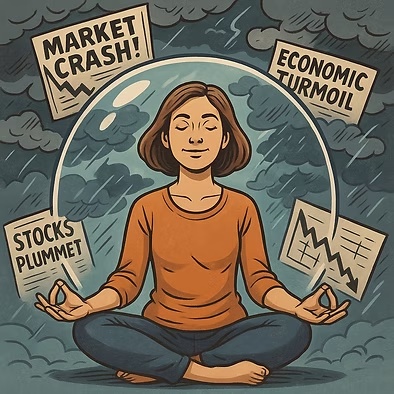
If you’ve ever checked your portfolio during a turbulent spell, you’ll know how different your thinking can feel compared with calmer periods. A few red arrows on a screen, an alarming headline, or a friend muttering about “the economy going off a cliff”, and suddenly your normally steady logic feels a bit wobbly.
This shift isn’t a flaw. It’s simply human.But understanding that shift, and planning for it, is one of the most powerful ways to protect your long-term financial wellbeing.
At TFP, we talk often about the emotional landscape of investing because the data is clear: it isn’t usually markets that derail people’s long-term plans. It’s our reactions to them.
Let’s explore why this happens, what really sits beneath sound investing decisions, and how to stay grounded when the world’s noise threatens to drown out your good judgement.
The simple truth we forget when markets wobble
Behind every fund line, share price or market index sits something undeniably ordinary and reassuring: thousands of real companies, run by real people, selling real things.
From your morning coffee to the software you use at work, you interact with these businesses daily. When you invest globally, you own a slice of that everyday ingenuity.
When the mood is steady, most investors understand this intuitively:
- businesses sell products
- customers keep consuming
- economies evolve
- innovation continues
And as profits grow over time, so does the value of your ownership.
But when markets become unsettled, whether due to a political shake-up, international tension, or a disruption of the week, that clear logic can quickly be overshadowed by something far louder: emotion.
Why fear can feel louder than facts
Our brains are wired to react swiftly to anything that might resemble danger. Thousands of years ago, this was life-saving. Today, the “danger” is often an unnerving headline or a dip on a chart… yet our emotional systems respond with the same urgency.
Here’s the challenge:
Logic is quiet. Fear is noisy.
Logic says:“Markets go up and down. This is normal. My plan already accounts for this.”
Fear says:“What if this is different? What if this time is the exception? Should I do something now?”
Fear is rarely about evidence.It’s about discomfort, uncertainty, and the feeling of losing control.
And because fear feels urgent, many people act on it… selling when markets fall, pausing contributions, or abandoning carefully built plans.
Ironically, these fear-driven decisions often create the very outcome people hoped to avoid: long-term loss.
Where clarity comes from: reconnecting with what investing really is
When markets are noisy, one of the most grounding steps you can take is to revisit the fundamentals:
1. You are an owner, not a gambler
You hold stakes in companies that adapt, grow and evolve. Their value is tied to long-term earnings, not the emotion of the week.
2. Volatility is not a threat, it’s part of the journey
If prices only ever moved upward in a straight line, returns would be tiny. Fluctuations aren’t a flaw; they are the cost of receiving long-term growth.
3. Markets recover… they always have
Not instantly, not predictably, but consistently. Every downturn has been followed by recovery, and often by new highs.
4. You don’t have to navigate storms alone
One of the biggest advantages of having advisers is having someone by your side who sees beyond the moment and keeps your long-term vision intact.
What calm investors do differently
Through years of coaching clients, particularly during difficult periods like early 2020, we’ve observed patterns that distinguish those who stay the course from those who panic:
⭐ They return to their plan, not the headlines
Your long-term plan was built to absorb temporary shocks. The news cycle wasn’t.
⭐ They ask, “What has actually changed for me?”
Nine times out of ten, the answer is nothing.
⭐ They lean on conversations, not instinct
Talking things through helps regulate the emotional “spike” that fear creates. This is why our review meetings often feel part financial planning, part emotional/behavioural coaching… and intentionally so.
⭐ They understand that doing nothing is often the bravest decision
Holding steady when the world feels jittery is not passivity. It’s discipline.
A practical TFP tool: The “Now vs. Later” check-in
Next time fear creeps in, use this 30-second exercise:
Now: What emotion am I feeling right now? Fear? Frustration? Urgency?
Later: What would the version of me in 10 years want me to do today?
(Spoiler: future-you rarely says, “Sell everything immediately.”)
This shift reconnects you with your long-term self… the one investing was designed for.
Why fear fades and your plan doesn’t
Every period of market anxiety eventually loses its power. Confidence returns, the news cycle moves on, and markets stabilise. Meanwhile, the investors who kept a cool head quietly benefit from:
- reinvested dividends,
- long-term growth,
- their original strategy working as designed.
The temporary discomfort of volatility is the gateway to long-term reward.The permanence comes not from markets, but from your behaviour.
And the truth is, you don’t need to be fearless.You just need support when fear tries to take the wheel.
We’re here to steady the noise
You never need to manage market nerves on your own. If current events, headlines or conversations have left you feeling unsettled, reach out. Talking things through calmly, clearly and without judgement, is one of the most valuable services we provide.
Your long-term financial independence isn’t built on reacting to short-term events.It’s built on clarity, consistency and confidence.
We’re here to help you keep all three.