

For many people, the hardest part of retirement isn’t building the pot… it’s knowing how to use it without constantly worrying about running out.
Even clients who have saved diligently often find the same questions lingering in the background:
“Can I really afford this?”
“What if markets fall just as I start taking income?”
“Should I be spending less, just in case?”
That underlying uncertainty can quietly erode enjoyment of retirement.
That’s exactly why we often use a time-segmented bucket approach. It’s a simple, practical way of organising retirement money so you can see, clearly, where your income is coming from, how long it’s designed to last, and how the rest of your portfolio is supporting your future.
Most importantly, it helps turn retirement from a constant financial calculation into something that feels more settled and spendable.
What Is the Bucket Approach?
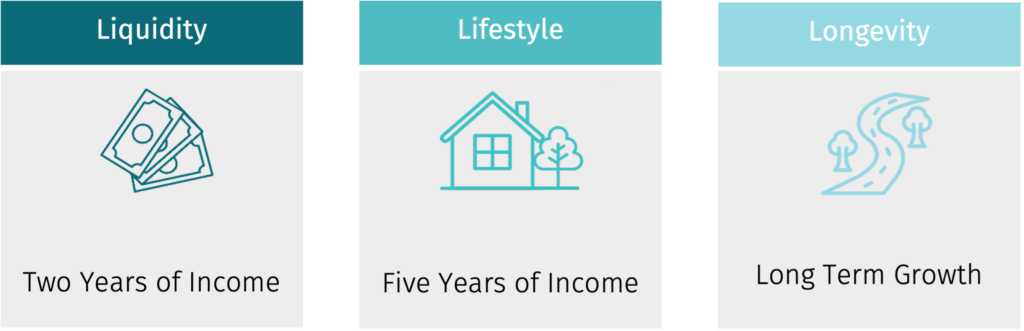
At its core, the bucket approach divides your retirement portfolio into three distinct parts, each with a very specific job to do.
Rather than viewing your investments as one large pot, we align different portions of your money with when it’s likely to be needed.
1. The Liquidity Bucket (0–2 years)
This bucket typically holds around two years of planned income in very low-risk, highly stable assets such as cash or cash-like investments.
Its sole purpose is to fund day-to-day spending, paying the bills, covering lifestyle costs, and ensuring income continues smoothly regardless of what markets are doing.
Why this matters:
You know, with confidence, that your income is covered for the next 24 months, even during market turbulence.
That certainty alone often removes a huge amount of stress.
2. The Lifestyle Bucket (2–7 years)
The Lifestyle bucket is invested more cautiously, using lower-volatility assets designed to provide steadier returns over the medium term.
Its role is to act as a buffer and refill point, gradually replenishing the Liquidity bucket as income is taken.
Why this matters:
If markets fall, you still have several years of planned spending invested more defensively. That significantly reduces the risk of selling long-term investments at the wrong time, when values are temporarily down.
3. The Longevity Bucket (7+ years)
This is your long-term growth bucket. It contains money that isn’t needed for many years and can therefore be invested in higher-growth assets.
Because this money has time on its side, it can ride out market ups and downs and benefit from long-term compounding.
Why this matters:
Your later-life income, and potential legacy, has a better chance of keeping pace with inflation, rather than being slowly eroded by it.
Why This Approach Helps You Feel More in Control
No investment strategy removes risk entirely. But the bucket approach changes how risk shows up in your day-to-day life, and that’s often the difference between feeling anxious and feeling in control.
1. It protects income during market downturns
When markets fall, it’s completely natural to feel nervous about withdrawals.
With a bucket structure:
- your next two years of income are already set aside
- the following years are invested more cautiously
- long-term growth assets can be left alone to recover
This means you’re not forced into uncomfortable decisions at precisely the wrong moment.
2. It makes spending feel safer and more intentional
One of the most common retirement worries we see is around discretionary spending… holidays, gifts to family, or one-off expenses.
Buckets create a clearer mental framework:
- where income is coming from
- how long it’s designed to last
- how the plan adapts when markets change
That clarity helps spending feel deliberate rather than risky. Clients stop asking, “Can I afford this?” and start asking, “Is this worth it to me?”, which is a much healthier place to be.
3. It supports better long-term outcomes
By giving long-term investments the breathing space they need, the bucket approach helps avoid one of the biggest risks in retirement: reacting emotionally to short-term market movements.
Staying invested through downturns, rather than selling in panic, is often one of the most important contributors to long-term success over a 20–30 year retirement.
4. It introduces structure and discipline
The system itself is deliberately simple:
- income is taken from the Liquidity bucket
- the Lifestyle bucket refills it over time
- the Longevity bucket is reviewed periodically to see whether money should “flow down”
There’s no guesswork, no sudden changes to income, and no need to respond to every market headline.
How We Manage the Buckets in Practice
The buckets are typically reviewed annually as part of your wider financial planning review.
In broad terms:
- If markets have been reasonably normal and long-term investments haven’t fallen significantly (around 15% or more), we top up the shorter-term buckets as planned.
- If markets have experienced a sharper downturn, we pause selling long-term assets and instead rely on the Lifestyle bucket to keep income flowing.
This approach gives growth assets the time they need to recover (particularly when they’re under the most pressure) while keeping day-to-day income steady.
A Simple Example
A recent client couple needed £60,000 per year from their portfolio. Their £1.2 million retirement pot was structured as follows:
- £120,000 in the Liquidity bucket (two years of income)
- £300,000 in the Lifestyle bucket (five years of lower-volatility investments)
- the remaining balance in the Longevity bucket for long-term growth
When markets dipped last year, their income continued exactly as planned.
They didn’t feel the need to cancel holidays or cut back on spending — because the money funding their lifestyle wasn’t exposed to the short-term market fall.
That’s the bucket approach doing its job.
Why This Matters for Your Retirement
The time-segmented bucket approach is designed to help you:
- spend with confidence
- stay invested through market ups and downs
- protect long-term growth
- simplify complex decisions
- keep income stable, even when markets are volatile
At TFP, this reflects how we think about money more broadly… practical, structured, and built around real life rather than market theory.
Most importantly, it helps turn retirement planning from a source of anxiety into something that quietly supports the life you want to live.