

When planning for retirement, most people focus on their investment portfolios, private pensions, or ISA balances.
Yet one of the most powerful, reliable, and inflation‑linked sources of income is often overlooked: the UK State Pension.
There has been ongoing public debate about its future – including speculation about the triple lock, potential increases to State Pension age, and its long‑term affordability. But despite the political noise, the State Pension remains a cornerstone of retirement security for millions of people. Many are proud to finally say, “I’ve claimed my State Pension,” but far fewer understand how dramatically it can improve the sustainability of their retirement plan.
It may not feel exciting. It’s rarely described as a “strategy”. It certainly doesn’t generate headlines in the same way as markets do.
But when we model retirement plans for clients, the State Pension frequently turns out to be one of the most powerful drivers of long-term sustainability.
Let’s look at why.
A Real Planning Scenario: Tom & Flo
Tom (57) and Flo (59) are already retired
- £250,000 in ISAs
- £750,000 in uncrystallised pensions
- 60/40 global equity & bond portfolio
- Spending goal: £50,000 per year
At first glance, £1 million of invested assets feels substantial. Many would assume that’s more than enough.
But retirement planning isn’t about gut feel, it’s all about how income, tax and investment returns interact over time.
Scenario 1: No State Pension Included
If Tom and Flo withdraw £50,000 in year one, that’s a 5% withdrawal rate.
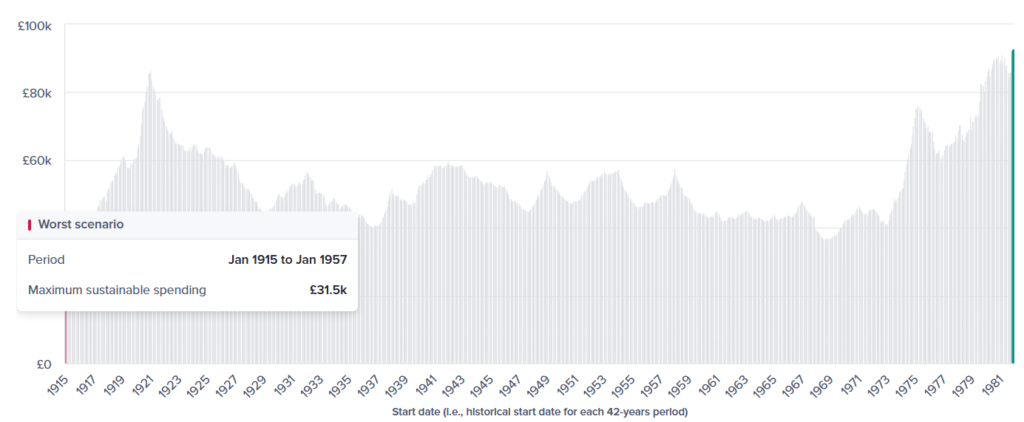
Using historic stress testing across 804 market scenarios spanning 111 years (modelled in Timeline with inflation-adjusted withdrawals), their results look like this:
- Probability of success to age 100: 51%
- Worst-case sustainable spending: £31,500 per year
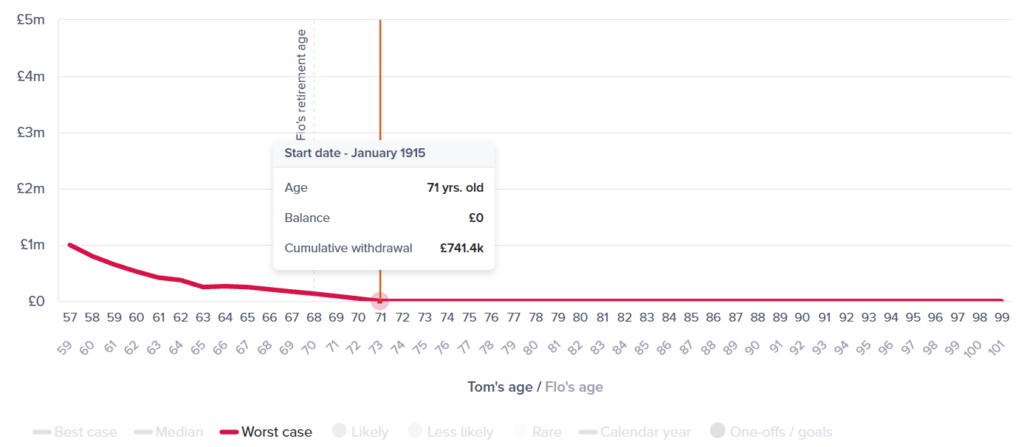
- Worst-case portfolio depletion age: 71
That last number is sobering.
In poor market conditions, their portfolio could be exhausted at 71… nearly 30 years short of their planning horizon.
This is sequence-of-returns risk in action. If markets are unkind in the early years of retirement, withdrawing 5% plus inflation can permanently damage a portfolio.
And this is before we even factor in tax planning decisions around how pension income is drawn.
Scenario 2: Adding Two Full State Pensions
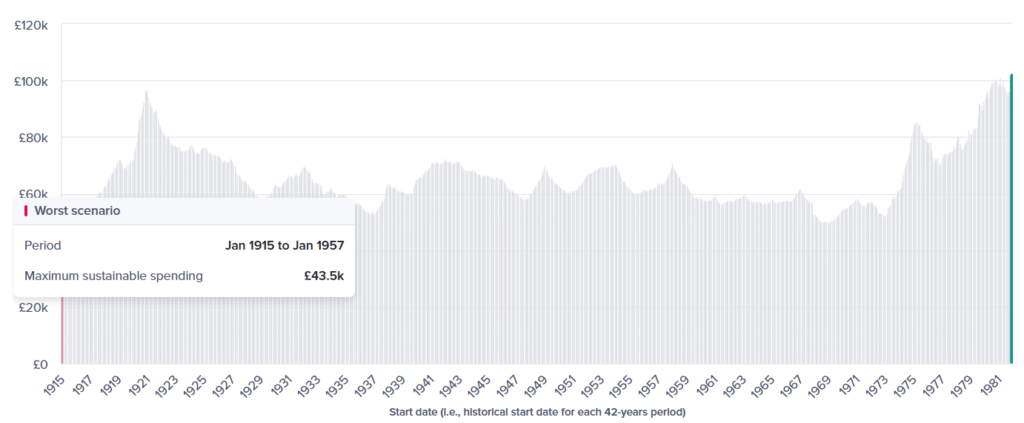
By adding two state pension (currently £11,973 per annum)
With these incomes added:
- Success rate jumps from 51% → 98%
- Worst‑case spending rises from £31,500 → £43,500/year
- Withdrawal rate falls
And crucially:
Worst‑case portfolio depletion age with State Pension: age 78
The State Pension increases their financial resilience by seven additional years.
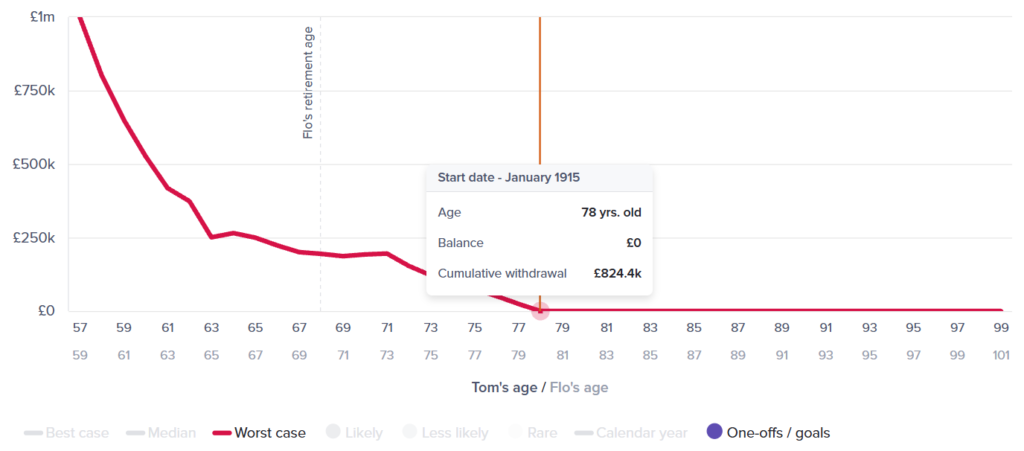
This is one of the clearest demonstrations of its value — the State Pension doesn’t just add income; it materially enhances portfolio longevity.
Why the State Pension Makes Such a Big Difference
1. It Reduces Pressure on Investments
Guaranteed income reduces the strain on their portfolio, cutting the withdrawal rate
2. It’s Guaranteed for Life
The State Pension provides lifelong, government‑backed income that is unaffected by market volatility.
3. It Rises Over Time
The Triple Lock guarantees that the UK State Pension increases each year by the highest of inflation, average earnings growth, or 2.5%.
4. It Improves Worst‑Case Outcomes
As shown, the State Pension increased Tom & Flo’s worst‑case longevity by seven years, dramatically improving their financial resilience.
Understanding State Pension Deferral
A commonly misunderstood point is that your State Pension does NOT start automatically – you must actively claim it. If you don’t, it is automatically deferred.
Should You Defer?
For those reaching State Pension age after 6 April 2016, deferral increases the pension by:
1% for every 9 weeks deferred (around 5.8% per year).
Example: Tom Defers for Two Years
Using the illustrative full pension of £230.25 per week:
- Tom gives up roughly £24,245 over two years.
- His annual pension increases to about £14,038.
- That’s roughly £1,459 more per year for life.
To “break even”, he would need to live to around age 83.
ONS data suggests his life expectancy is around 84.
So statistically, it may pay off.
But here’s the key: this is deeply personal.
If Tom were in poor health, deferral may be unwise.
If he is still working and paying higher-rate tax, deferral could be sensible.
If he simply doesn’t need the income yet and wants more guaranteed later-life security, it can be attractive.
In our planning work, we model both options so clients can see the trade-offs clearly.
Tax Planning Matters Too
The interaction between State Pension and private pensions is often overlooked.
The State Pension is taxable income.
That means once it begins:
- It uses part (or all) of your Personal Allowance
- It can push pension withdrawals into higher tax bands
- It affects how much you might sensibly draw from ISAs vs pensions
This is why retirement income planning isn’t just about “how much have I got?”
It’s about sequencing:
- What do we draw first?
- How do we use allowances efficiently?
- How do we keep lifetime tax as low as reasonably possible?
- How do we smooth income across decades?
The State Pension is a core piece of that puzzle.
Check Your Forecast (It’s More Important Than You Think)
Many people assume they will receive the full State Pension, but don’t check.
You should review:
- Your State Pension forecast
- Your National Insurance record
- Whether you have 35 qualifying years
If there are gaps, voluntary National Insurance contributions may be possible. In many cases, these can offer excellent value… but not always.
It depends on your broader plan.
And that’s the point.
The State Pension isn’t an isolated benefit. It’s part of an integrated retirement income strategy.
The Bigger Picture
When we build retirement plans at TFP, we don’t start with maximising returns.
We start with:
- Securing essential income
- Building tax-efficient withdrawal structures
- Reducing reliance on markets
- Creating spending confidence
The State Pension often plays a far bigger role in that story than people expect.
It may not feel glamorous.
But in many plans, it is the quiet difference between fragility and resilience.
If you’re approaching retirement and haven’t looked closely at your State Pension forecast, it’s worth doing.
Because sometimes the most powerful part of your financial plan is the one you’ve been overlooking.
Important Notes
- This article is not financial advice.
- Historical stress testing was performed using Timeline with inflation‑adjusted withdrawals.
- State Pension comparisons assume a weekly pension of £230.25, rising at 2.5% per year.