
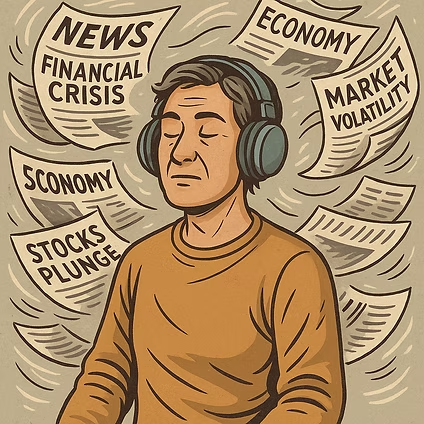
Staying Calm in a Noisy Financial World
If you’ve ever scrolled through the news on a quiet Sunday morning, you’ll know the feeling: one minute you’re enjoying your coffee, and the next you’re being warned about an impending financial crisis that apparently everyone else has already prepared for.
The language is dramatic.The timing is urgent.The confidence is absolute.
And suddenly, what was a relaxing morning turns into a moment of doubt: “Should I be doing something? Am I missing something? Is everyone else seeing danger that I’m not?”
If this sounds familiar, you’re not alone — and you’re certainly not at fault. We are all wired to respond to warnings far more strongly than to reassurance. A dramatic headline will always travel further and faster than a measured explanation.
But when you’re building wealth for decades, not days, it’s crucial to understand why these messages sound convincing, why they create anxiety, and why reacting to them can quietly sabotage your financial progress.
This article explores how to stay calm, grounded, and confident when the financial world starts shouting.
Why Dramatic Predictions Grab Us
Human beings survived for thousands of years by spotting danger early. Our ancestors didn’t have TV panels, podcasts or social media feeds, but they did have instincts honed for avoiding threats. That wiring hasn’t changed, even if the world around us has.
Today, instead of rustling bushes and storm clouds, we’re confronted with:
- sensational market forecasts
- bold claims about the “next crash”
- confident experts offering exact timelines
- comparisons to previous downturns
- speculation dressed as certainty
None of this is accidental. Fear draws attention, and attention is a business model.
This doesn’t mean the people making the predictions are malicious. But their incentives are different from yours. Commentators thrive on urgency; long-term investors thrive on patience.
Those two worlds rarely align.
The Illusion of Certainty
One of the most unsettling features of dramatic predictions is the tone of confidence. Statements such as:
- “This will definitely happen.”
- “Everyone should be preparing.”
- “The signs are obvious.”
…create the impression that the future is clear-cut and measurable.
But the financial system is influenced by thousands of variables, political decisions, technological shifts, human behaviour, global events, supply chains, confidence, innovation, and plain old randomness. No one can reliably predict their combined effect.
If anything, history shows the opposite:Markets spend far more time surprising experts than validating them.
At TFP, we often say: you don’t need to predict the future to enjoy it.
You simply need a plan that works regardless of the surprises.
The Real Cost of Reacting Too Quickly
Imagine you’re on a long motorway journey. You’ve planned your route. You’ve checked your fuel. You’ve timed your breaks. Suddenly a radio presenter says there “might” be traffic ahead based on a rumour someone phoned in with.
Do you:
A) take the next exit blindly, hoping for the best?
B) pause, take a breath, and check your planned route?
If you choose the first option, you might end up adding hours to your journey.
If you choose the second, you probably arrive on time.
Financially, it’s similar.
Reacting to dramatic predictions — even well-intentioned ones — can mean:
- selling at the wrong moment
- missing market recoveries
- interrupting compounding
- derailing a carefully structured investment strategy
- creating stress where none was needed
- building habits based on anxiety rather than clarity
Once a long-term plan is disrupted, it can take years to rebuild the confidence and structure that were lost in a moment of fear.
Your plan is designed to protect you from short-term noise… not encourage you to react to it.
An Anchor for Uncertain Times: Your Long-Term Plan
At the heart of every TFP financial plan is a simple principle:
You do not need to respond to every headline.
Your plan already accounts for:
- market ups and downs
- recessions and recoveries
- political shifts
- economic surprises
- periods of discomfort
- periods of exceptional growth
A well-constructed plan, one that incorporates diversification, discipline, resilience and regular reviews, is engineered to withstand uncertainty.
You don’t need to predict what happens next because your strategy already includes the possibility of many different futures.
This doesn’t mean we ignore risks.
It means we respond to them proportionately, thoughtfully, and with evidence, not adrenaline.
A Practical Way to Filter Financial Noise
Next time you encounter a dramatic prediction, try this simple three-question filter:
1. Does this person know my long-term goals?
If not, their urgency is unlikely to be relevant to your timeline.
2. Are they rewarded for being dramatic?
Media platforms benefit from attention, not accuracy.
3. Will reacting to this improve my life fifteen years from now?
That question alone removes 99% of the noise.
At TFP, part of our job is helping you build this filter into your own thinking, so that clarity becomes a habit, not a struggle.
A Calmer, More Confident Way Forward
Markets will rise, fall, wobble and surge, sometimes in the same year. Predictions will continue. Headlines will keep getting louder. And each time the cycle repeats, the warnings will feel familiar.
But your financial life is not built on predictions.
It’s built on:
- thoughtful planning
- wise decision-making
- steady saving
- sensible investment structures
- behavioural discipline
- a long-term partnership with people who know your story
We are here to help you stay grounded, keep perspective, and make decisions that support the life you want… not the noise of the moment.
Whatever the markets do next, you won’t face it alone.